Start with the place at the time
A family-history search can stall when a familiar present-day county name is treated as though it has always described the same place. Before deciding that a record is missing, ask which jurisdiction would have created or held that record at the date of the event. This question can redirect a search without requiring an assumption that the family moved.
The Westmoreland Historical Society warns that records relevant to county ancestors may be found in Bedford, Cumberland, or even Virginia for periods before 1773. [1] Its advice makes a useful research principle concrete: the name on today's map is not always the name under which an earlier record was organized. A place-and-date timeline belongs beside the family timeline.
Define the event before searching the name
Choose one event or relationship to investigate. Record the best-supported date range, the place as written in the existing source, and the question that remains open. A broad request for everything about a surname is difficult to evaluate because it does not identify which new information would count as progress.
An original research sheet might begin with an event, a person, a location, and the evidence already available. Keep an estimated date visibly different from a documented date. If several places share a name, list the candidates instead of choosing one prematurely. The aim is to reduce the search to a question that can be answered with a specific record or a clearly documented gap.
Keep geography and identity separate
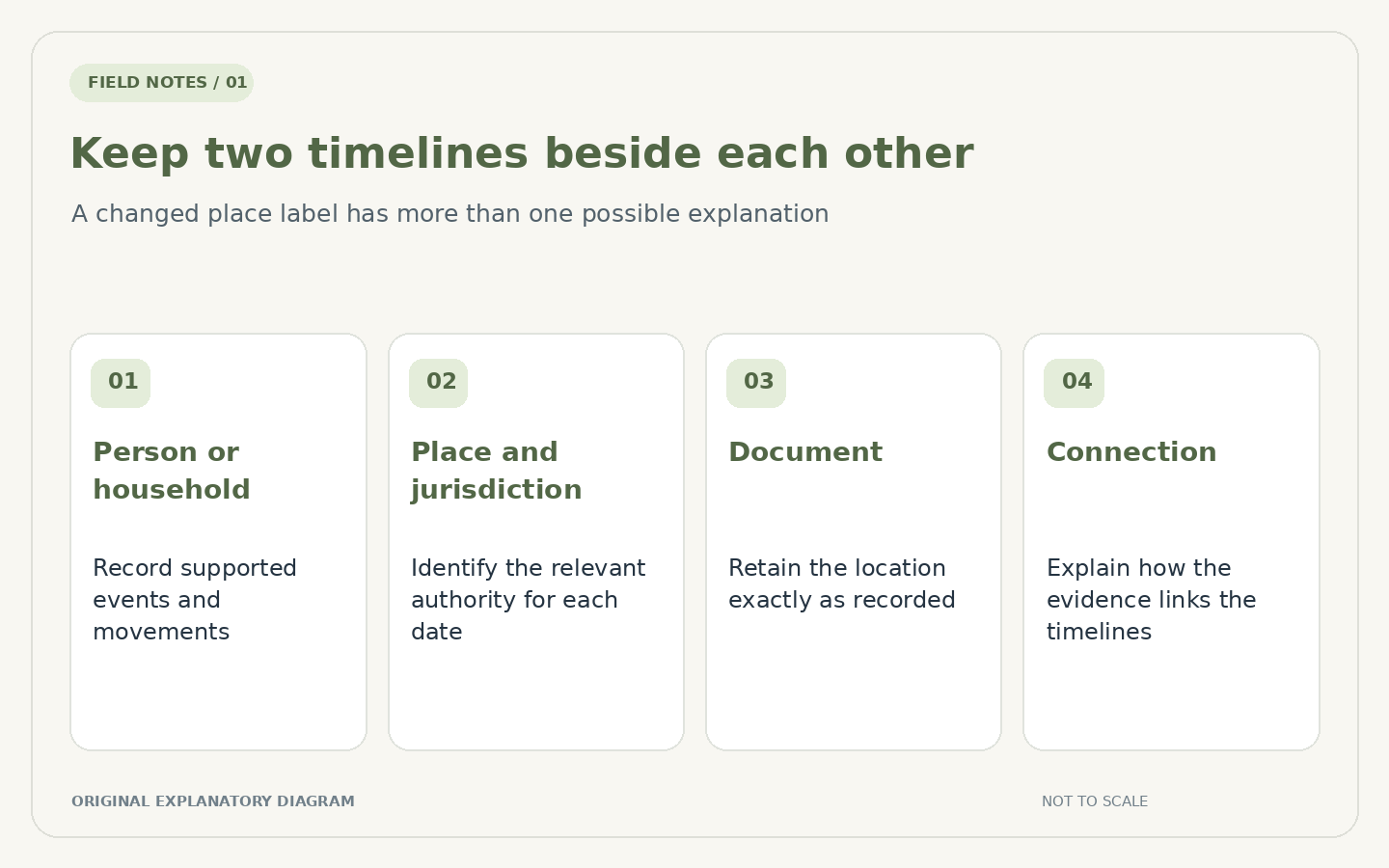
Create one timeline for the places being investigated and another for the person or household. The geographical timeline should show the jurisdictions relevant to the research question. The personal timeline should show only movements or events supported by evidence. Compare them before explaining a change in the location named on a record.
This prevents a common interpretive shortcut: treating a different county heading as proof of a journey. It also prevents the reverse error of assuming that a boundary change explains every difference. The two explanations need different evidence. A good research note identifies which possibility is supported and what additional source would distinguish it from the alternative.
Use census records for their actual contents
The National Archives explains that census schedules can provide names, ages, places, occupations, and other details, but the information collected differs by census year. Before 1850, federal population schedules generally named the household head rather than every individual. [2]
That variation matters when a search produces an apparent absence. First identify what the selected schedule was designed to record. A person who was not individually named in that format should not be described as missing from the household on that basis alone. Keep the form's structure beside the transcription so that later readers can understand the limits of the evidence.
Preserve competing matches until they can be distinguished
When several records could refer to the same person, maintain separate candidate entries. Compare the details that matter to the specific question rather than accepting the closest spelling as sufficient proof. A match should be explained through the combined evidence, including any discrepancies that remain unresolved.
For a practical comparison, use columns for the record reference, the stated information, the possible connection, and the uncertainty. Do not silently harmonize conflicting ages or relationships to make the timeline look tidy. A clear unresolved comparison is a stronger foundation for future work than a polished biography built on an unexamined identification. It also helps collaborators avoid repeating the same uncertain assumption.
Keep the original spelling in the transcription and place any search variants in a separate field. That lets the search be flexible without changing the evidence. When a candidate is rejected, note the reason briefly so that a later session does not rediscover it as a promising new match. This small habit makes a shared project easier to continue and preserves the difference between a search aid and the record itself.
Search the record series, not only the index
An index is a route into a collection, so keep its entry separate from the underlying record. When an image or original document is available, preserve the record's own wording and its surrounding headings. If the original is not accessible, state that the current finding is based on an index rather than implying that the full document has been examined.
The National Archives offers census research by year and identifies the kinds of records available through its resources. [2] Use the collection description to decide what can reasonably be searched next. A single unsuccessful name query is not the same as a documented search of every relevant record series for a place and period.
Make a focused request to a repository
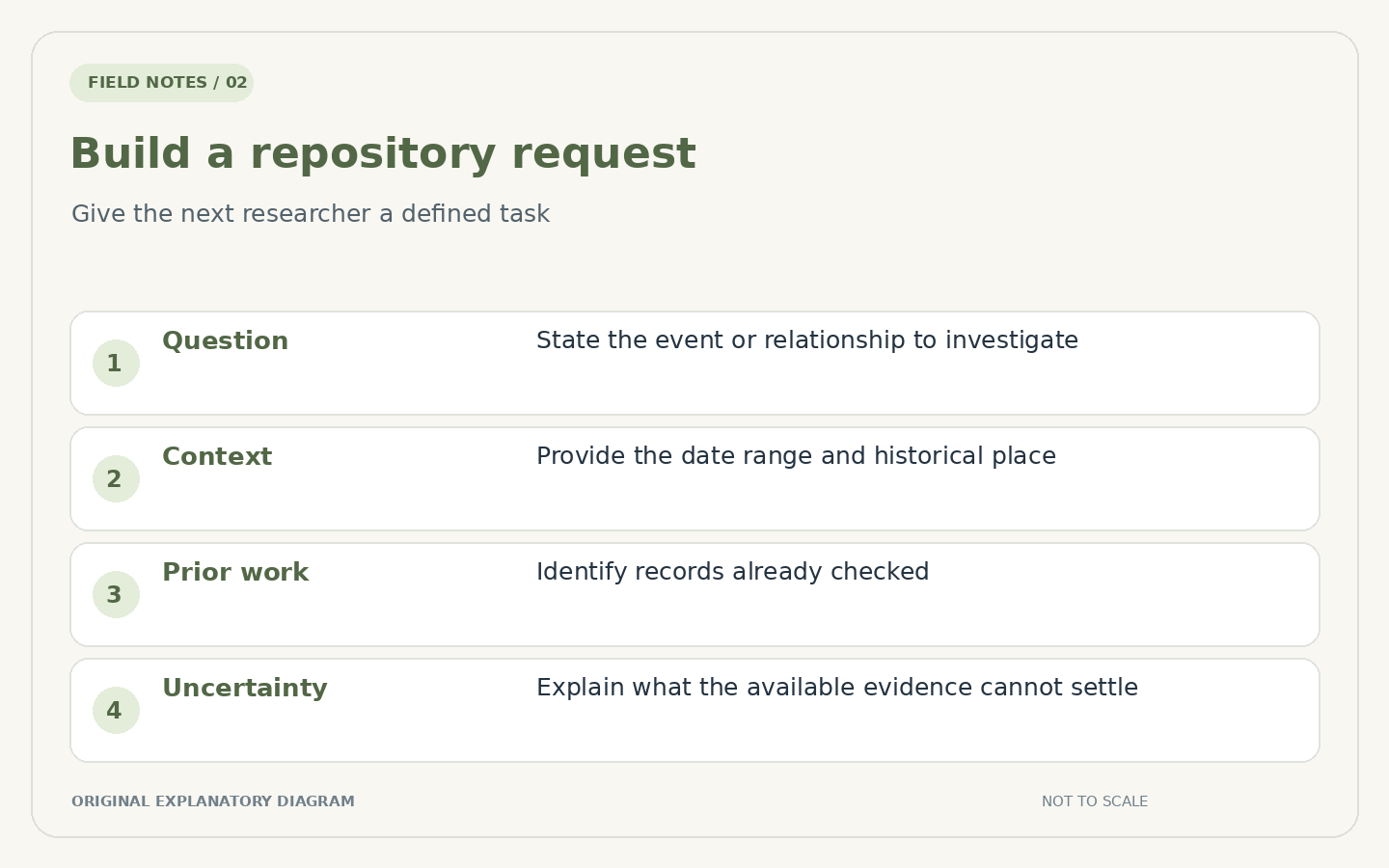
The Westmoreland Historical Society asks researchers to describe what they seek and identify sources already consulted. [1] This helps turn a request into a defined piece of work.
A useful inquiry can state the person or household, the date range, the historical place name, and the exact unresolved question. Add a short list of the records already checked and explain whether each produced a candidate, a negative result, or an inaccessible item. Keep the request readable. A carefully organized page is more useful than a large attachment of unexplained screenshots that requires the recipient to reconstruct the project before beginning.
Record negative findings precisely
Write down where, how, and for what period a search was performed. A negative result should identify the collection and method rather than becoming a statement that no record exists anywhere. The distinction matters when an index is incomplete, a date range is limited, or another jurisdiction may hold a different series.
An original search log can include a next-step field. That field should explain why another source is relevant, not simply list more places to try. For example, the next step might address an uncertain jurisdiction, a missing image, or a conflicting household relationship. This keeps the project moving through reasons rather than through an ever-expanding set of speculative searches.
Write the conclusion at the strength of the evidence
A family-history paragraph should distinguish an established connection from a plausible candidate. Include the record references that support the conclusion and retain any limitation that would matter to another researcher. The purpose is to make the reasoning inspectable, not to make every branch of the family tree appear equally certain.
The most useful outcome may be a corrected place name, a clearer date range, or a well-supported decision about where to search next. Those findings can unlock later work without inventing a movement or relationship. By keeping geography, chronology, and identity separate until the evidence connects them, a researcher produces a family history that can grow without losing its foundations.
Sources
- Library and Genealogy — Westmoreland Historical Society
- About Census Records — U.S. National Archives and Records Administration